
Why your explanation goes over your audience’s head (and 3 ways to meet them where they are)


When you explain something well, you’re not just compiling the information into a pretty package and then delivering it. You’re constructing a scenario where your audience can see what you see. If there’s anything you can do to make the picture clearer, do it. If there’s anything that gets in the way, eliminate it. That means: explaining technical terms rather than throwing them in unannounced; taking the time to think of an example your audience will understand; and removing anything and everything that obscures your message.
I mentioned the work of instructional guru Sigfried Engelmann in my article on the power of examples and non-examples. He argued that a learner should never have to guess what distinguishes a positive example from a negative one. In the same vein, your audience should never be left guessing about any part of your explanation. It’s your job to construct a route where the only destination is understanding, with no chance to miss a turn.
Wherever possible, it’s best to show, not tell. You can do that through examples, a story, or an image. But sometimes you do just have to tell! In that case, I find it helpful to look at explanation through three lenses: structure, detail, and audience.
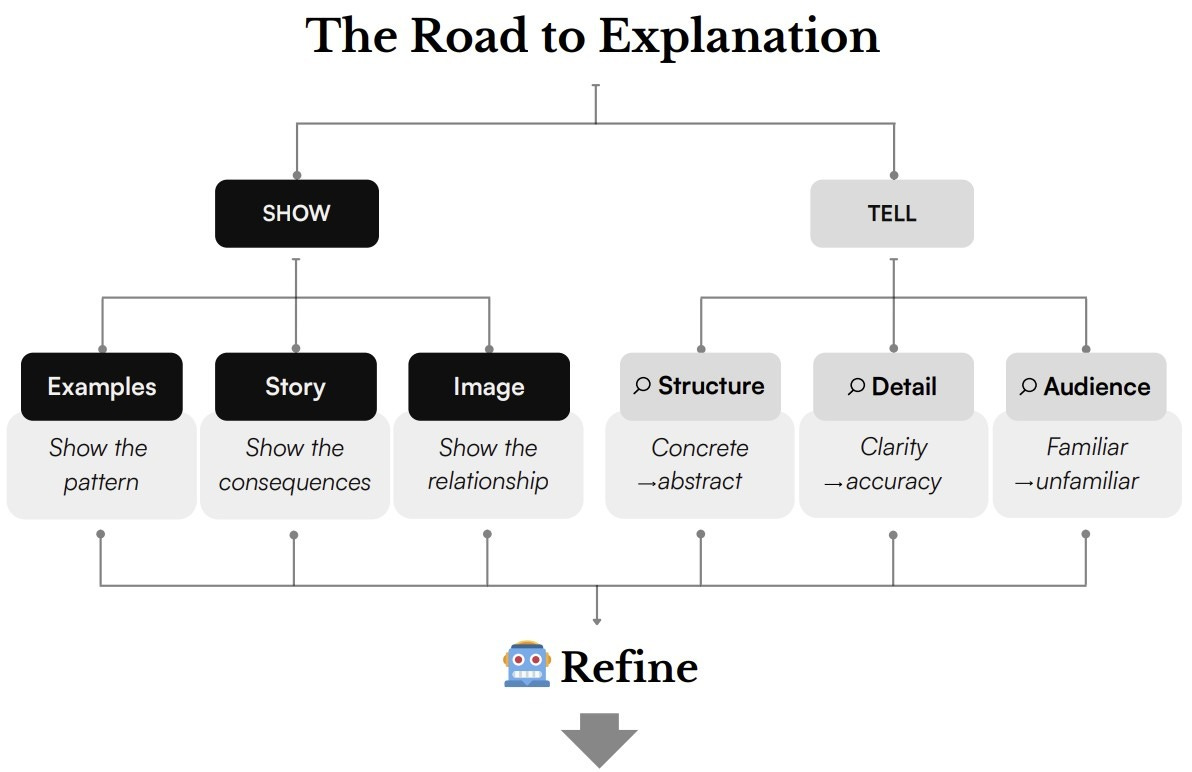
Image taken from my book, ExplAIn Yourself .
Structure is about the order in which you present ideas. It’s what allows an explanation to build. Start with the concrete before moving to the abstract. Explain what something is before getting into why it works. Set up the problem before delivering the solution. Create a headache before dishing out the aspirin.
Detail is about the content of the explanation itself. It’s about using fewer words – but not at the cost of clarity. Presenting comparable ideas with comparable structure. Breaking complex ideas down into their smallest possible units. And choosing clarity over accuracy, because people can’t understand what they can’t follow.
Audience concerns the person on the other side of the explanation. Cater to their limited working memory. Introduce ideas in a way that reduces cognitive load, starting with what’s familiar, delaying or avoiding jargon. And above all, do the work so your audience doesn’t have to.
The lenses overlap. And they should. An explanation’s structure rightly depends on its audience! But applying this framework helps avoid falling into common explanation mistakes. So look through the lenses, and if you miss something in one, you’re bound to pick it up in another.

Checklist: The Three Lenses of Explanation
This article summarises a bunch of ideas that I’ve covered in more detail in previous posts. To tie it all together, here’s a checklist you can apply to any explanation to refine it through the three lenses of Structure, Audience and Detail (S.A.D. if you want an easy way to remember them!).
1. Structure: Get the order right
Start with the concrete, then move to the abstract
Explain what something is before diving into why it matters
Introduce the problem (headache) before offering the solution (aspirin)
2. Detail: Make it sharp and simple
Use fewer words
Present comparable ideas in a format that makes the difference obvious
Break ideas into their smallest indivisible parts
Choose clarity over accuracy
3. Audience: Do the thinking for them
Respect the limits of working memory
Eliminate extraneous cognitive load
Start with what’s familiar, then introduce what’s new
Delay or avoid jargon unless it truly helps