
The three words that’ll transform the way you explain
Well, technically it’s four

Read this tourist brochure description of a town:
The town has a charming, welcoming atmosphere that makes visitors feel at home.
Now try this:
Washing lines stretch across balconies. Children play football in the streets. The air is rich with the smell of freshly baked bread, and laughter echoes from the local cafe.
I’d wager that the second description leaves a stronger impression.
We tend to think of explanation as a kind of talking: a controlled outpouring of knowledge from someone who understands to someone who doesn’t. The expert has the meaning, selects the right words, and delivers it. The novice receives it, nods, and understands. But a good explanation doesn’t transfer knowledge like pouring liquid from one glass into another. It constructs the conditions under which someone can see what you see.
In my previous post I discussed how we’ve evolved to learn through pattern recognition. Here, I’ll explore how we can communicate in a way that caters to such biologically primary skills.
Examples
I’m going to explain the term aerodynamic:
An object is aerodynamic if its shape allows it to move through a fluid with minimal resistance or turbulence.
Got it? You may have an idea. But unless you already know what “resistance” and “turbulence” look like in motion, that sentence is going to require you to read it twice.
Instead, consider three examples:
a plane in flight;
a Formula 1 car taking a corner;
a falcon diving toward prey.
These are all aerodynamic, because their shape allows them to cut through the air quickly. Now you get the picture. With a few images, the abstract concept becomes tangible. You see not only what aerodynamic means, but why it matters. And if you saw the definition again now, you’d understand it differently.
The human brain is extraordinarily adept at pattern recognition. Long before we had language, we learned by observing correlations: the rustle in the grass that precedes danger, the darkening sky that signals rain. We don’t merely take in information. We look for patterns.
We can harness that same instinct when we explain. If you want someone to understand an unfamiliar concept, sometimes the most effective move is to provide a few carefully selected examples and let the pattern do the work.
Let’s look at another explanation that would better be illustrated through examples:
Symmetry is a transformation, such as a rotation, reflection or translation, that leaves an object unchanged.
Come again? Unless you’re already familiar with some of these abstract terms, the definition isn’t particularly helpful.
Instead, think of the following:
a butterfly’s wings;
a snowflake;
a classical Greek temple.
Now that we’ve seen symmetry in action, we can put a definition to it. And then – if we want to – we can distinguish between different types of symmetry: the reflectional symmetry in a butterfly’s wings; the rotational symmetry of a snowflake. But we first need examples to bring the concept to life.
Non-examples
Positive examples are effective. But a non-example can make them even more effective. Take symmetry:
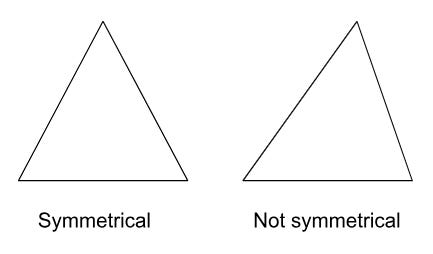
The near miss shows the boundary of the concept.
Next, let’s look at a commonly misused piece of punctuation: the semicolon. Suppose I tell you this rule:
A semicolon connects two independent clauses.
Now tell me, is the semicolon appropriate in the following sentence?
“I like oranges; but I love apples.”
So, what’s your answer?
How certain are you? Are the two clauses independent? Are you sure?
Most people hesitate. They recognise that something feels off, but they don’t yet know why. The rule hasn’t prepared them for this specific situation.
Now look at this set of examples and non-examples:
❌ “I love to dance; yet I dance to live.”
✅ “I love to dance; I dance to live.”❌ “I like spaghetti; although I hate ravioli.”
✅ “I like spaghetti; I hate ravioli.”
Now the pattern becomes clear. The semicolon doesn’t work with a connective like “yet”, “although” or “but”. For the clauses to be independent, they must stand on their own. The way the examples and non-examples are presented helps reveal this. Just one thing changes in each pair. So that’s the one feature you pay attention to.
This technique is called minimal difference. It was formalised by educational researcher Siegfried Engelmann in his book, Theory of Instruction. Engelmann argued that the learner should never have to guess what makes an example right or wrong. The distinction should be obvious, because the contrast has been designed to isolate it. If the learner fails, it’s not because the concept is difficult. It’s because the examples were poorly constructed.
For Engelmann, teaching was not a matter of simplifying content, but of controlling the variables. In his view, the ideal sequence begins with a pair of examples that are as similar as possible in every irrelevant respect, and differ only in the property being taught. This design makes the critical feature unavoidable. It emerges as the only possible explanation for the difference in outcome.
Once the edge of the category is clear, we can expand the range.
✅ “I wanted to speak up; I stayed silent.”
✅ “The data looked promising; the model didn’t hold.”
✅ “He seemed confident; he was bluffing.”
This kind of variation helps the learner generalise. The structure remains the same, but the surface details shift. That tells the learner what’s important, and what’s not. Then, by returning to a minimally different incorrect case, the contrast sharpens further:
❌ “He seemed confident; however he was bluffing.”
The value of this method is not just in eliciting accurate responses. It builds intuition. Take a look at this diagram.
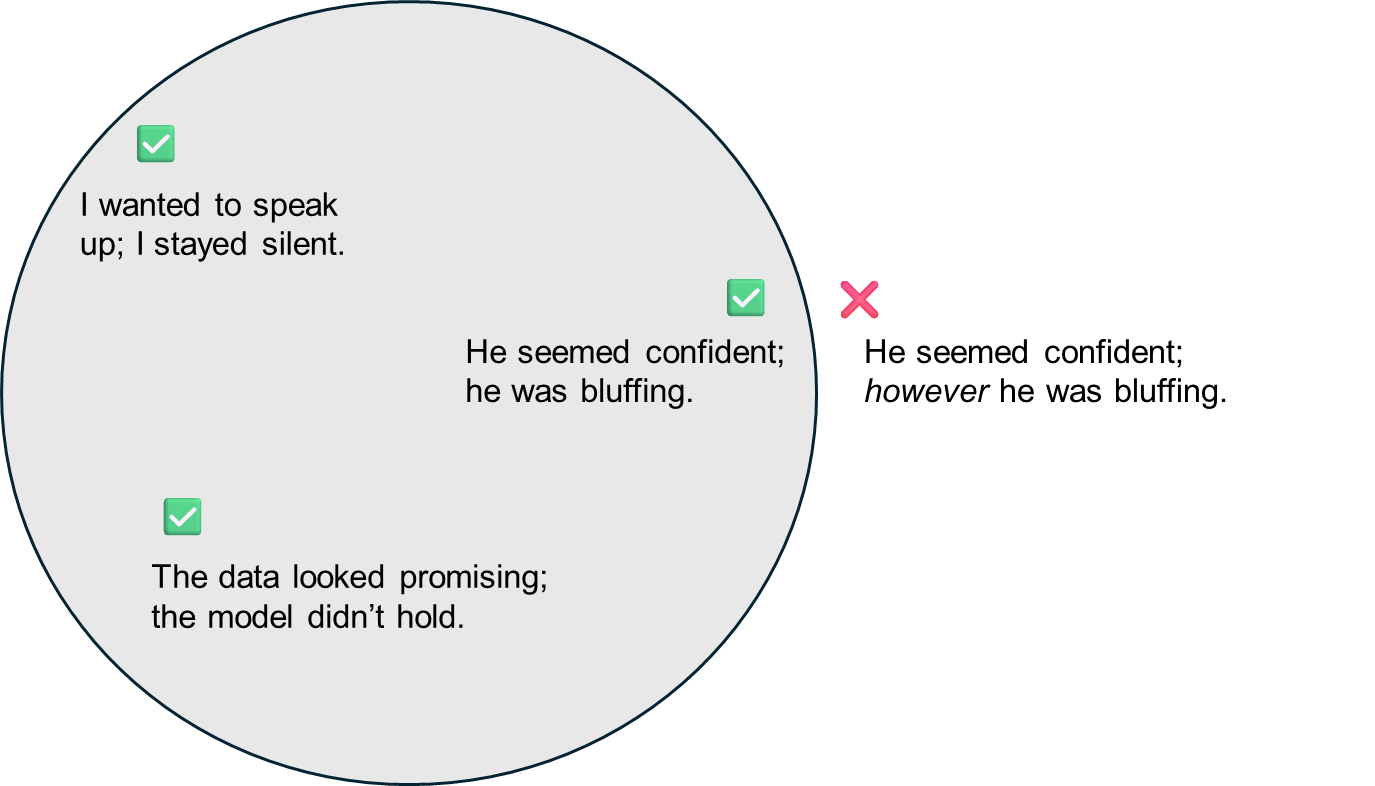
We can treat a concept like a circle: positive examples inside; non-examples outside. The positive examples map out the domain; non-examples show what doesn’t fit. A minimally different non-example reveals the boundary. Now, the learner is no longer applying a rule; they’ve developed a feeling for what’s right.
It’s worth noting, too, that a non-example that’s nearly correct tends to be more helpful than a non-example that’s obviously wrong (e.g. “this use of a semicolon; is obviously wrong!”).
Build it up
What we’ve just looked at is a contrastive sequence, with minimal changes that isolate a critical feature. Sometimes, however, you may wish to construct an additive sequence that builds an idea, step by step, accumulating its features one at a time.
Take the challenge of writing a catchy YouTube title. Suppose I gave you the following explanation:
To write a compelling YouTube title, you should make it specific, curiosity-driven, and emotionally engaging
Now, based on this, have a go at thinking up a title for a video about how users can get more views on their videos. Give it a go!
How was that? I’m guessing quite tough.
Instead, look at this sequence:
How to Get More Views on YouTube
⬇️
3 Proven Tricks to Get More Views on YouTube⬇️
3 Proven Tricks to 10X Your YouTube Views⬇️
3 Proven Tricks to 10X Your YouTube Views in One Week⬇️
3 Proven Tricks to 10X Your YouTube Views in One Week (Most Creators Ignore These…)
Now you’ve got a much clearer picture of what good looks like. Moreover, each addition isolates a specific feature of a good title – a number, a promise of speed or surprise – while the other details remain unchanged. The journey reveals the individual features and illustrates their power, without you having to say a word. The sequence wouldn’t be nearly as rich if it jumped straight from start to finish.
Both these types of example sequence – contrastive and additive – rely on the same premise: comparison helps the brain understand. A well-structured set of examples allows the learner to infer the concept, rather than memorise its description. The key takeaway for us explainers is this: a carefully crafted example sequence can make your message impossible to miss, without you explaining anything at all. In short: show, don’t tell.
This article is based on a chapter from my book, ExplAIn Yourself, where you can find more examples (and non-examples!) of good explanations.